Rules: www.mydct.com/yahtzee/rules.doc (same as this page, but in a Word Document)
Game Sheet: www.mydct.com/Yahtzee/Yahtzee.xls
Screen Shot: www.mydct.com/Yahtzee/yahtzee1.jpg - Dave early game
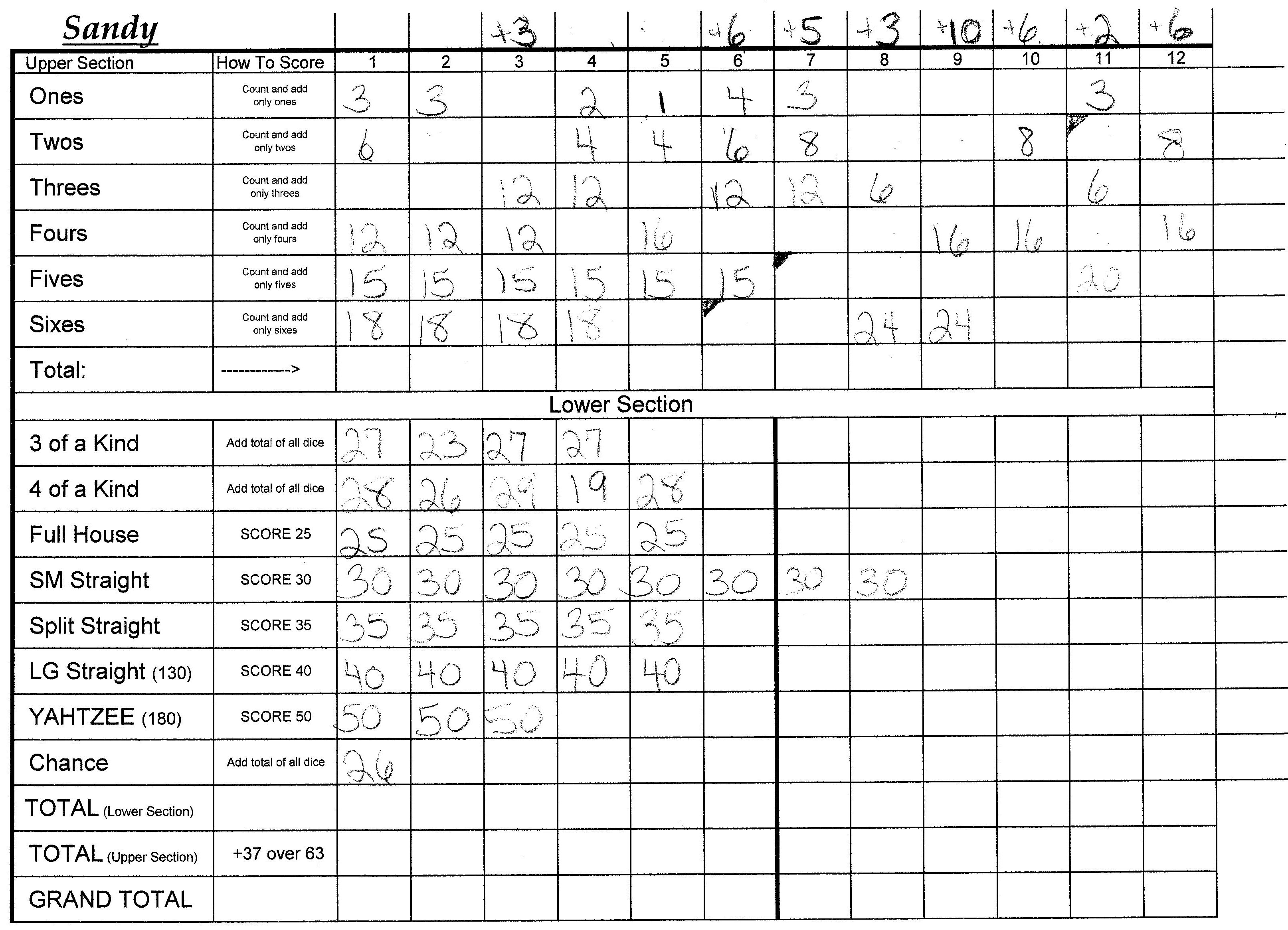
Screen Shot: www.mydct.com/Yahtzee/yahtzee2.jpg - Sandy early game
Screen Shot: www.mydct.com/Yahtzee/yahtzee3.jpg - Dave finished game
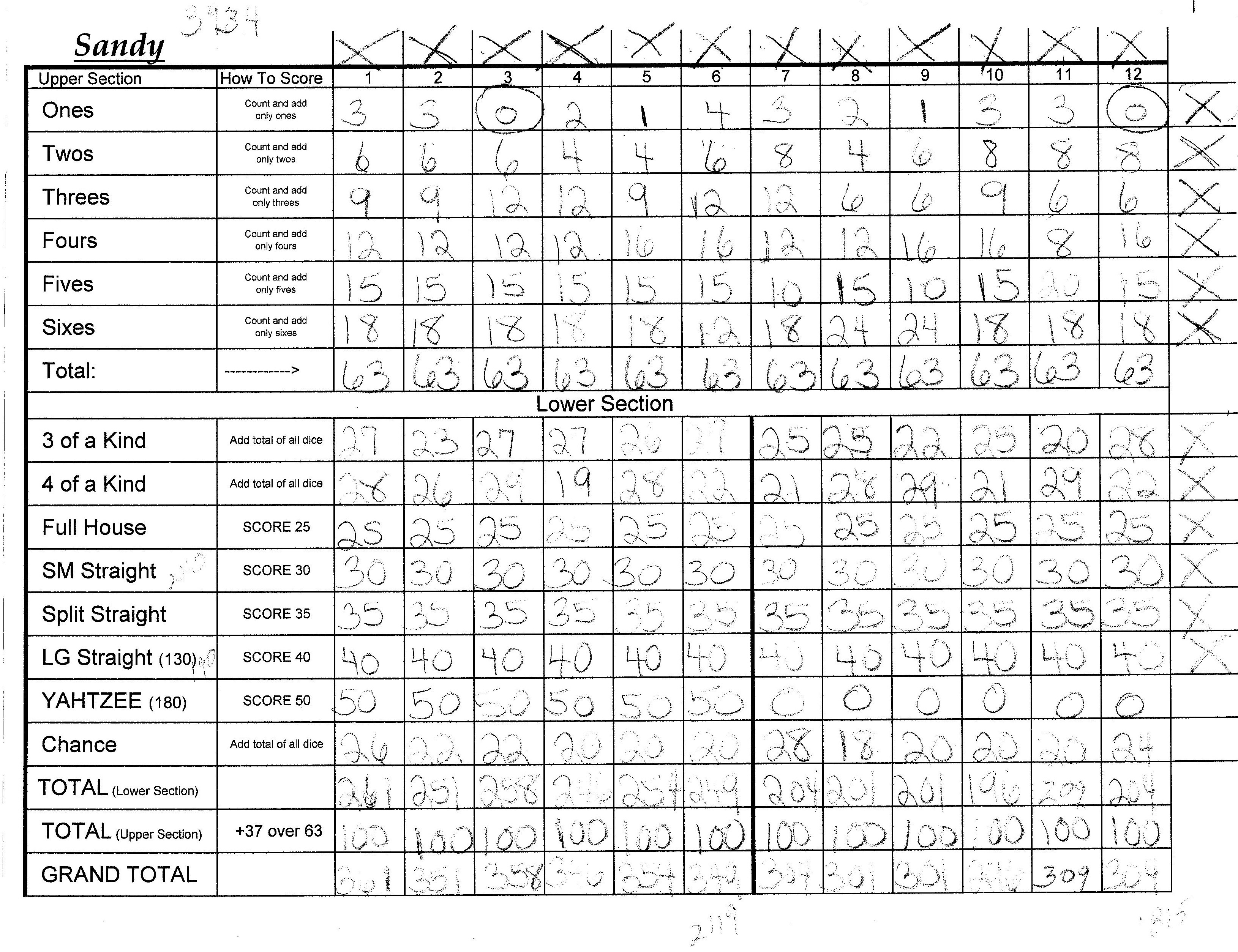
Screen Shot: www.mydct.com/Yahtzee/yahtzee4.jpg - Sandy finished game
Rules & Strategy
Mega Yahtzee
Although Mega Yahtzee is based on regular Yahtzee, over the years it has evolved into a very different game. The main difference is the length of play, a normal game between two people can last anywhere between 3 to 5 hours, and is often played over several days, or with several breaks during game play. The other main difference is the game play strategy; the way the 5 dice are applied towards the game sheet may be very familiar, but to completely fill in every cell of the game sheet can take a lot of thought, luck, and strategy that makes Mega Yahtzee unique.
The Game Sheet
Note: It might be easier to understand the upcoming rules and strategies if you have a game sheet in front of you. I will try to have a downloadable copy online somewhere, and will list the URL at the end of what you are reading. I am using a very old copy of Excel, version 2002, which is all I have. It is currently set up to print perfectly on a single sheet of 8 ½ X 11 paper, though you may need to make some changes to do so depending on what version of Excel or whatever program you are using.
The obvious difference with the game sheet compared to a normal Yahtzee game is the size. You are playing twelve games of Yahtzee all at the same time. With a few exceptions, the “hands” you create in Mega Yahtzee are the same as regular Yahtzee, the top section is for ones through sixes, and the bottom section if for Full Houses, Straights, Yahtzees, and so on. One addition is the “Split Straight”, which is a straight using all five dice with a missing number, i.e. 1, 2, 4, 5, 6. Although we went through many different new “hands”, i.e. all odd / all even dice, most didn’t work well for one reason or another and were discarded. The total score for one game of Mega Yahtzee is the total of all 12 columns added to each other. The game sheet is not complete until every cell is filled in.
The Rules
Herein lies the fun part… This game has developed over the course of many years, and countless games, and rules have been added and changed constantly, up until the day of writing this. There are a lot of rules that are different from normal Yahtzee, I will list them, and for some I will give an explanation as to why the rule exists. Note: You will definitely need to use a pencil, and have a good eraser when you play this game.
(1). Scoring: Normal Yahtzee rules apply for the most part, with some exceptions, and with some new rules. Each player uses 5 dice. The dice are rolled, at which time the player can re-roll one to five dice again. And then the player can re-roll one to five dice a third time. The goal is to create a “hand” with the five dice that corresponds to a described hand on the left column of the score sheet. When the player is done, he must write the correct score described in the second column of the score sheet. The score is written into the cells under the columns marked 1 through 12 in the green row at the top of the page, to the right of the corresponding hand listed in the first column. Once a score is written into a cell, it can not be changed, except under three circumstances: 1. A score can be moved as many times as needed while it is still the current player’s turn. For the other two reasons, see rule x and rule y below.
The score does not have to be written in any particular order in the row it belongs. For instance, if a player gets a Full House, he can write the score 25 in scoring column 1 through 12, the score does not have to be written in cell 1 and the next Full House score written in column 2. The reason for this will become clear below.
(2). No Touchie: No player shall touch the dice until the current player says they are done. Please be patient, as the game progresses, different strategies can cause a player to change their mind on how to apply a score several times. Once the current player has written the score in the final cell and tells the next player that he is done, the next player may pick up the dice and take their first roll of that round.
(3). McGuffin: – Named for the term in Golf where a player hits a bad shot, and takes another shot, ignoring the first shot. Yes, I know this is actually a “Mulligan”, but ignorance on my part called it a “McGuffin” (which is a film term for something in a movie that is necessary to the plot, but is irrelevant in itself, i.e. the glowing briefcase in Pulp Fiction) the first time the rule was used, and it kind of stuck. So McGuffin it is.
In Mega Yahtzee, the first 20 entire rounds of play are known as McGuffin rounds. What this means is, if a player takes all three rolls and does not have any normal hand, the player takes all five dice and starts their three rolls again. Each and every player does this for all of the first 20 rounds, and then “normal” play begins, as long as all players are happy with their rolls at the end of the 20 rounds.
Note: There is no limit to how many times a player can reroll the dice after three rolls without a legitimate hand. BUT: If the player does have a legitimate hand at the end of the third roll, he must end his turn and use the dice as they are. For instance, the player rolls 6, 6, 4, 2, 1. He wants to try to get 6’s, so he rolls the other three dice and gets 5, 2, 2. He rolls these three dice for his third roll, and gets 5, 4, 3. Now, the player can NOT have a McGuffin and roll again, because he has a small straight (6, 5, 4, 3). This stops the player from rolling non-stop trying to get all 4 of a Kinds or Yahtzees.
This seems extreme, but there is a reason. Mainly, as stated above, to play a full game of Mega Yahtzee, you are committing 3 to 5 hours (generally closer to 5 than 3) of your life. If the beginning of your game is crappy, most likely the rest of your game is not going to be much better, and you’ll be playing catch-up for the rest of the game. I’ve done it, and it’s not fun.
What constitutes a good beginning? That is going to be up to each individual. If you are expecting to start with 10 Yahtzees out of the first 20 rounds, and you won’t play unless you have at least that good of a start, you’ll never play a game. As you learn the strategies of the game (see below), you will come to understand what constitutes a good start. Generally having 3 to 5 advantages in the upper section of the score sheet is what you are looking for, which will be explained later. Your best bet is to play through a couple of games regardless of how good or bad your first 20 rounds are to get a feel for what you consider a good or bad start.
If one player decides that he doesn’t want to start a game after round 20, all players must erase their current score sheets and start over. I know this sounds like a strange rule, but it will make a lot more sense when you’ve played the game for a while. In all the years my wife and I have played this, I think we’ve re-started the game 2 or 3 times.
(4.) Upper Section Perfect Scores: The upper section is scored by rolling the dice and getting the number listed in the left column. For instance if the player ends up with three dice showing the number 5, he would enter “15” in one of the cells to the right of the “Fives” cell in the first column.
The upper section is one of the most important parts of the game, and the part of the score sheet that takes a lot of strategy to get right. The reason for this is, you want to have every column, 1 through 12, to come out perfect every time. “Perfect” means that the numbers in the upper section of each column should add up to exactly 63. If a player gets exactly three of each number in each cell of a column (i.e. three 1’s, three 2’s, etc), the total of the six cells added together will come out to 63. The cells are added up and the total is written in the “Total” row, which should show up blue if you have a color printer. Whatever number you end up with in the Total cell, if it is 63 or over, you add 37 to it and write it in the TOTAL (Upper Section) row at the bottom of the page. Any score under 63 will not gain a bonus at the bottom of the page. This total will be added to the total from the Lower Section columns at the end of the game. Every three columns from the Upper Section that are perfect (score of 63) and added to 37 at the bottom (which equals 100) will give the player an extra round at the end of the game. These extra rounds can be used to fill in any cells that are marked with a zero (reasons for marking a zero will be listed below), and can very well mean the difference between winning or losing the game when the scores are very close. A perfect game (twelve scores of exactly 100) would give the player four extra rounds at the end of the game.
Now, the chances of getting exactly three of each number 72 times (the number of cells in the upper section) are just about impossible, but you can use Upper Section 4 of a kinds to make it a little easier. For instance, say you take your first roll in a round and you get two 5’s. You roll the remaining three dice and you get two more 5’s. You roll the remaining one dice and get a 3. You could use these dice in the Lower Section’s four of a kind, or even Chance, but a good strategy is to use all four 5’s in the upper section. Four 5’s equal 20, so you would write 20 in the correct cell. Let’s write it all the way to the right, in column marked 12 in green. With 20 in this cell, if you get three of everything else in that column, your total will be over 63, so you need to get rid of those 5 points. How? Easy, just get two 2’s and two 3’s in the same column, get three of everything else, and everything will equal out to 63. This bit of finagling is a HUGE part of the game, and will become a major part of your strategy. This will be discussed in more detail below under Strategies.
5. Zeros: Later in the game, each player will most likely end up with at least a few rounds where their final dice just don’t fit anywhere on the game sheet. Or, it may be a bunch of low numbers that the player deems too low to write in a Chance cell. In this case, the player can write a 0 in any cell for that round. This 0 may be moved later. For instance, the player has almost the whole sheet done, but needs a lot of Large Straights, so there are several empty cells in the Large Straights row. Because of a bad dice roll, the player ends up writing a 0 in one of the Large Straights cells. Later in the game, the player fills in all of the other cells in the Large Straights row, and then rolls another Large Straight, but the final cell has the 0 in it. The 0 may be erased and moved to another open cell, and the score for the Large Straight written in the Large Straights open cell. Zeros may be moved as many times as needed, as long as the player rolls something that would normally be written into the cell where the zero is.
6. Jinx Replay: This rule takes a bit of concentration to catch, and may go unnoticed many times. When a player rolls the exact same numbers on three dice in the second and third roll, the three dice may be rolled again. For instance, the player’s first roll includes two 6’s, and these two dice are set aside in the hopes that the player can roll more 6’s. On the player’s second roll (with the 3 unused dice from the first roll) he rolls a 2, 3, and 5. None of these dice are wanted, so the player rolls all three dice again, and again rolls a 2, 3, and 5. This is a “Jinx”, and the player can roll the three dice again. As long as the same three numbers are rolled, the player can continue to roll the 3 dice. If even one dice is different, the player’s round is over. This only works with 3 dice, it does not apply to any other number of dice rolled in the second and third rolls.
7. Perfect 63’s Extra Rolls: This is a somewhat dangerous move and should be used with caution. If a player has rolled three times in a round, and decides that he wants to gamble, he can declare that he is taking another roll. Up to 5 dice can be rolled in this fourth roll. But, on the player’s next turn, he is only allowed two rolls total. Also, the player can go for broke and take a FIFTH roll, but on his next turn he is only allowed ONE roll of the dice. If the player rolls more than the allowed rolls on his next turn and the other player(s) catch him, he forfeits his turn and must enter a Zero in a cell of his choosing. If he rolls more than allowed and no one catches him, and the next player rolls the dice, there is no penalty and the player has beaten the system.
8. Mega Yahtzee: There are twelve cells for each hand on the score sheet, and this includes Yahtzees. If a player fills all twelve Yahtzee cells in one game, and then gets a 13th Yahtzee, he can put the correct score into any open cell on the bottom section of the score sheet. If a 3 of a kind, 4 of a kind, or Chance cell is used, the total of all five dice is the score written in. If a Full House or any of the Straights cells are used, enter the normal score for that cell as if you had rolled that particular hand. Note: In about 5 years of playing this game, more than 12 Yahtzees has only been achieved once.
9. Scoring Dice: This pertains to the Upper Section only. When a player is finished a round, if he wants to use the score on the upper section, he must score ALL of the numbers for the cell he chooses. For example, the player is trying to get 3’s to fill in a cell in the upper section. After two rolls, he only has two 3’s, but he needs three. In the last roll, he gets two more 3’s, giving him a total of four 3’s. If the player wants to fill in a cell in the 3’s row, he would have to add up all 3’s, in this example for a score of 12. Although Four of a Kind is usually a good thing in the Upper Section, sometimes is will put a player over the perfect score of 63, so four of a number could be catastrophic. In this example, the player could use the dice in the Lower Section, in the 4 of a Kind, 3 of a Kind, or Chance, as long as there is a cell open. Or, he may place a 0 in any cell for that round.
On the other hand, a player does not have to roll three times in a round. In the same example, if the player got three 3’s in the first or second roll of the dice, he could stop there and enter his score without taking the last roll. This rule is only for the Upper Section, on the Lower Section, 4 of a Kind can be scored in a 3 of a Kind cell, and a Large Straight can be written into a Small Straight cell.
Strategies
The way to win is to have the highest score at the end of the game. When the game first starts, it is very easy, you have all the cells you want to put your score into. But as the game progresses, and there are less and less cells, trying to fill in every cell gets very hard to do. With this in mind, you will find that just about every round in the game has to be played carefully. Often there will be choices that will affect your entire game play. For instance, after your three rolls you end up with 6, 6, 6, 4, 4. You could use the three 6’s in the top section’s Sixes row, or in the bottom section’s Three of a Kind or Full House row. These decision get harder and harder as the game progresses, and eventually you will end up having to choose where to put a 0 when your final roll doesn’t give you anything that will go anywhere. The three rows where this is most likely to happen are the Four of a Kind, Large Straight, and of course Yahtzee, though I’ve had games where just about any row except Chance ended up with at least one Zero in it.
The Upper Section is extremely important for winning the game, getting a perfect 63 twelve times takes a lot of work. Also, working on the Upper and Lower sections simultaneously, you have to balance how much you concentrate on going for scores for both sections. Fill one section up too soon, and rolls that would fit perfectly in a cell in the filled section and doesn’t work anywhere on the other section will result in a Zero.
The Upper Section: This part of the game is almost a game unto itself, your goal to get 63 in each column will take a lot of skill, strategy, and luck. The McGuffin rolls are a good time to work on getting Four of a Kinds to put in the Upper Section, though there’s no reason you can’t work on it for a good part of the game. My strategy to keep track of things it to put Four of a Kinds all the way to the right, starting in column 12, then the next Four of a Kind in column 11, and so on. At the top of the Upper Section there are lines like a cell without a top, this area can be used to write in how many extra points are currently in each column. For instance, a round finishes with four 5’s, and the player writes 20 in the 5’s cell of column 12. He could then write “+5” in the section above that column, so a quick glance would show exactly what he could use in the case of a bad roll. Later in the game, the player ends a round with two 2’s, he could write 4 in the 2’s cell of column 12. He is using part of the extra 5 to cover the missing 2, so there is now only 3 extra points left in that column. The player would erase the +5 at the top of the column and write +3 there. This extra three points could be used to cover a round ending with two 3’s, or at the extreme it could cover three 1’s (covering all three numbers in a cell is known as a “Sinkhole).
A player can have more than one Four of a Kind in a column. For instance, four 5’s would give an extra 5 points in one column. In another round the player gets four 1’s, and enters a 4 in the same column’s 1’s cell. This would give a total of 6 extra points in that column, which would be handy if the player is later trying to get three 6’s and only gets two at the end of the round. As many Four of a Kinds can be used in a column as a player wants, but he has to be careful to use up the extra points to get a perfect 63.
A player may also find himself in a deficit in the upper section, and have to play catch up. This can be a dangerous situation if the player is trying for perfect 63’s. For example, a player is going for 2’s, but only ends the round with two 2’s. He does not have any extra points in any column to cover the missing two points. In this case, the player could put the 4 points in one of the columns, with the hope of getting a four of a kind later in the game that will cover the deficit. If he is using the open boxes at the top of the Upper Section to keep track of numbers, he would write a -2 above this column. Later, if the player gets say four 5’s in a round, he could write this in the same column, and then change the -2 to a +3.
The top section is the major part of the game, but the player can not forget about the lower section. Knowing how to use the dice wisely takes a while to get used to, when starting out a player might find he has the Upper Section done, and hardly any of the lower section, and then he is getting 0’s trying to fill in hard to get cells (like Large Straights or Four of a Kinds). Conversely, if the player fills in the bottom section to quickly, he might find himself at the end of the game trying to fill several cells in the Upper Section that have to be filled exactly to get a perfect 63. If the dice aren’t falling the way you need them, this is a game killer, I’ve gotten eight or nine 0’s in a row trying to get three 5’s once to finish my upper section.
The Lower Section: While you are working away at the Upper Section, don’t forget the Lower Section. You’ll generally find one or two rows in the Lower Section taking a lot longer to fill than the other rows (Usually the Large Straights and Four of a Kinds, though it could just as easily be Full Houses). When you get a high scoring hand, like 6, 6, 6, 5, 5, you can use it in the 6’s in the Upper Section, or the Three of a Kinds and Full House in the Lower Section. This gets harder when you have a good Four of a Kind, a 6, 6, 6, 6, 5 would give you four 6’s in a column in the Upper Section and make your life a lot easier (One extra 6 can cover bad rolls of two 3’s, two 2’s, and two 1’s in a single column). But, you also need a total of twelve Four of a Kinds filled in the Lower Section, and these can be very hard to get when you absolutely have to near the end of the game.
The Perfect Game: Getting a whole sheet filled in without any 0’s is not impossible, but close. Mainly because it means you would have to get at least twelve Yahtzees. Getting every cell filled except for some 0’s in some of your Yahtzee cells is very hard to do, there’s a lot of luck needed on top of good strategic play.
Perfect 63’s: I talk a lot about getting Perfect 63’s in the Upper Section, because getting enough of them can easily win the game for a player. For every three Perfect 63’s a player gets, he gets a free round (three rolls of the dice) at the end of the game, when all of the cells are filled in. With twelve Perfect 63’s, that’s four free rounds of play. With these rolls, the player can try to replace any 0’s on his score sheet, but he of course has to finish the round with the correct hand to replace that particular cell. If you’ve played a really good game, and you only have 0’s in Yahtzee cells, then that’s all you can roll for.
That’s about all I can think of at the moment. I’d be interested in how other people play this, as I’ve only been playing it with my wife, and we’re more helping each other with strategies instead of trying to beat each other. We’ve tried and dropped a lot of different rules throughout the years, and narrowed them down to what you’ve read here. Good luck, enjoy, don’t go too crazy, this is a MARATHON game, if you start getting bad rolls one after the other, take a break, and come back to the game later or even the next day. Sometimes it will feel like you can’t roll anything you are trying for, other times you’ll get back to back Yahtzees or a bunch of Large Straights on one roll of the dice. It’s all chance, but sometimes I swear the Yahtzee gods are out to get me…